
Home / Review
Dicevaders Review
Dice you can bend, scores that balloon, a brutal top end

Dicevaders: 95% positive from 1,060 Steam reviews, 24-hour peak of 130 players, priced at $14.99, SteamGame.ai potential score 86/100 (data as of 2026-11-19). Source: SteamGame.ai (Find the next hit before it hits.)
Pros
- Dice you can reroll and nudge, so a bad table is rarely fatal
- Lean rules that still end in absurd score swings
- Polished presentation and a UI that explains itself
Cons
- Chapter six and the top difficulties strip builds apart
- The winning line narrows to a few core pieces
- Late-game depth thins for long-haul players
Six columns, three dice, and a board of units waiting for the right pip. Dicevaders builds a full roguelike deckbuilder out of that, and the reception leans hard in its favor, with 95% positive across 1,050 Steam reviews and an Overwhelmingly Positive label. What players keep praising is the room the build space gives them and the grip they get on the dice themselves, since rerolls and pip nudges turn a bad table into a problem you can work. The complaint that recurs most sits at the far end of the curve, where the hardest difficulties and chapter six answer a strong build by taking pieces of it away.
How a turn plays out
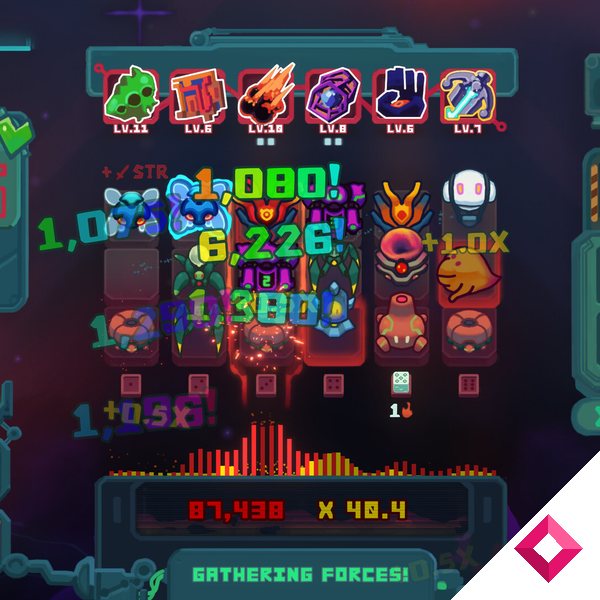
Every turn opens with three base dice. Each pip points at one of six columns, and whatever unit or artifact sits there triggers and scores, so the board is the deck. Between turns you spend money on units, on extra tiles and on artifact upgrades, then push the round's score threshold higher. Players describe the rules as lean enough to absorb in a run or two, and one reviewer at 72 hours calls the mechanics simple and consistent from the first turn to the last. The thinking goes into the build instead. One player describes the roll itself as a slot machine, with all the work pushed onto what you put on the board.
the game is not built out enough. they focused a lot on cooking up unique mechanics, but they didn't build on them enough. It feels like you get a tutorial version of everyone and then end up with same late game build.
Dice manipulation is where the design earns trust. Players describe rerolls and small pip adjustments as the difference between a run that dies early and one that keeps rolling, and the longer sessions back it up. A player at 38 hours says the game felt punishing at first and then clicked, and now wins more often than not. The pushback comes at the top. A few players report that shop rarity and key drops decide high-difficulty runs before the dice do, and when the pieces never show, the mitigation stops covering for it. On a normal run the luck feels handled; on the hardest ones it stops feeling handled.

Ask whether the build space stays open and the reviews split along the calendar. The first week of release brought praise for a game that pushes you to pivot and spread out, with one player noting that stacking a single engine forever is what makes this genre go stale and that Dicevaders dodges it. Late October and November brought the opposite read. Players describe every commander converging on the same handful of pieces, one of them calling the roster skins on one strategy, and another saying the unique mechanics never grow past their tutorial version. One detractor frames the whole thing as a good 10 to 15 hours before the pull fades. That later read matters if you plan to keep playing after the credits.
The wall at the top
Difficulty is the loudest grievance in the sample, and it has a specific shape. Several players point at chapter six and the top tiers, where bosses lock artifact slots, cut off perks or swallow relics, and describe the result as a fight against your own build. One walks through a final boss that limits resets, movement, artifacts and scoring while stacking its own defense, so a build that finally comes online knocks off one bar of three. Several players draw a line between modifiers that make you think and the ones that simply remove options, and they put the highest tier on the wrong side of it.
Become the enemy of the last game, with different rules and gameplay? Very cool I liked the last game I like this one. Character designs are cool and buildcrafting seems pretty flexible. Slime goat
Presentation carries a lot of the goodwill. Players call the animations simple but fun, the UI clear enough to read a packed board at a glance, and the audiovisual feedback strong enough that scoring lands on its own. A late-October review adds a rare note of dissent, saying the music is well made but sparse and more melancholy than the StarVaders soundtrack. The shared universe does real work for returning players: same world, flipped allegiance, and one player lists the reversal of playing the invaders among the best things the game does.

This review is based on 79 Steam player reviews and store data. See all reviews on Steam →
Quick answers
Does Dicevaders play well on a controller or a Steam Deck?
One review from late October calls controller support and Steam Deck performance great, and praises how much of the screen clutter can be switched off. Nobody else in the sample mentions hardware at all, so treat that as a single good report rather than a pattern.
How long does a run take?
No review in the sample puts a number on it. One player does describe runs as quick and easy to pick up and put down, in the same way as StarVaders, which points to short sessions that fit around other things. That is one description, so it tells you the shape rather than the clock.
By the NumbersUpdated 2026-11-19. Data updates on a daily schedule.
- Potential score
- 86 list metric, not a quality score
- Positive (all languages)
- 95% Overwhelmingly Positive
- Total reviews (all languages)
- 1,060
- New reviews/day (7d)
- 3
- Peak players (24h)
- 130
- Price
- $14.99
- Release date
- Sep 29, 2026
- Developer
- Pengonauts
- Publisher
- Playstack
- Est. sales
- 31.8K~63.6K rough estimate from review count
Source: public Steam store pages and player reviews. Review counts, positive share and daily new reviews cover all languages; the player peak is the highest count in the last 24 hours; estimated sales are a rough estimate based on review count, for reference only. Updated 2026-11-19; data updates on a daily schedule. Methodology
Daily New Reviews (all languages)
Is interest rising or fading?
Developer View
- Developer
- Pengonauts
- Publisher
- Playstack
- Developer's games on Steam
- 2 incl. this one; matched by developer name, may be off
- Early Access
- No
The store page has no AI-generated content disclosure.
More reviews

The Loopler Review
Combolands: Roguelike Citybuilder Review
