
Home / Review
Never Sort By Color Review
Addictive brick-sorting flow and interactive builds hampered by rough performance and bugs.

Contents
Never Sort By Color: 85% positive from 307 Steam reviews, 24-hour peak of 1,671 players, priced at $9.99, SteamGame.ai potential score 82/100 (data as of 2026-11-19). Source: SteamGame.ai (Find the next hit before it hits.)
Pros
- Deeply satisfying brick-sorting flow that pairs well with podcasts or shows
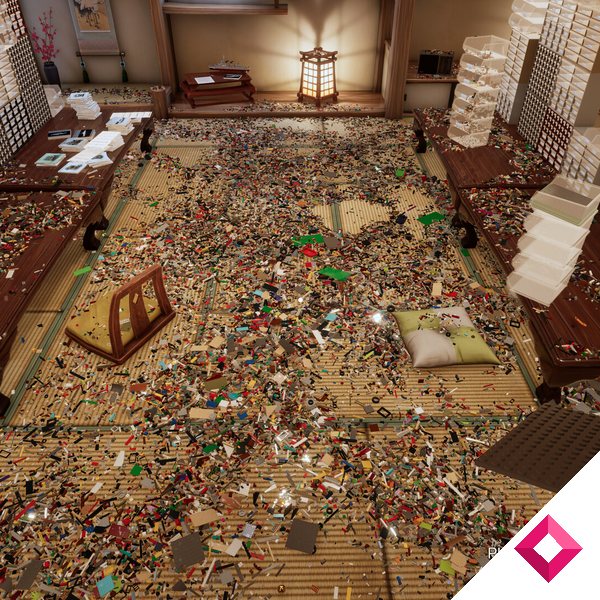
- Massive, realistic brick pile with specialized sieves and interactive MOC builds
- Dozens of hours of organizing content for $9.99
Cons
- Severe frame rate drops, high RAM usage, and crashes when moving large piles
- Clunky bin-packing physics and reports of bricks clipping out of bounds
- No free-build mode outside of fixed instruction manuals
Dumping tens of thousands of plastic toy bricks across a living room floor sounds like a barefoot nightmare, yet Never Sort By Color turns that mountainous mess into a hypnotic organizing simulation. Released on November 10, 2026 for $9.99, the game holds a Very Positive rating on Steam with 85% positive reviews across 307 total entries as of November 19. Across a sample of 67 post-launch reviews, many players praise the meditative flow of sifting through massive piles with magnet gloves and sieves before watching completed models snap together, Making it an easy recommendation for background play. At the same time, several negative reviews warn that severe frame rate drops, memory leaks, crashes, and missing-brick bugs can derail the path to 100% completion.
Sifting the Plastic Mountain
Sorting a pile that reaches up to 100,000 bricks works because the toolset is built specifically around the quirks of plastic blocks. Cast as the heir to an uncle's dismantled collection, you vacuum up loose parts with a magnet glove, highlight elusive pieces with part-seeking vision, and shake loads through specialized sieves that filter bricks by size or label. Many players highlight how closely the sheer volume and piece modeling capture the nostalgia of dumping out a family LEGO collection, pulling you into a deep flow state where six or nine hours pass in a single sitting. A couple of reviews single out the size and label sieves as clever additions that set the game apart from standard tidying sims. Because the core loop carries no timers or fail states, several reviews recommend putting on a podcast, audiobook, or television series in the background while you methodically clear the floor.
A bit more then your basic sorting game with some great challenges relaxing to spent a little wile just sorting bricks every now and again
Snap-Together Payoffs and Limits
Categorizing every last stud pays off once you start pulling parts from your labeled drawers to assemble MOC builds. Several reviews celebrate the moment bricks fly out of their containers and snap together automatically according to the instruction books, especially since you can shrink down to explore or drive the finished models and even import custom MOC files from the internet. At $9.99, many players feel the dozens of hours required to organize the mountain and complete the catalog deliver strong value, with one fan logging 95.6 hours in the full release after spending 120 hours in the demo. That payoff comes with a creative catch, however. A couple of critiques express disappointment that you cannot free-build your own designs from scratch or manually place each brick step by step, since every model must follow a preset blueprint.

Getting to those builds also requires pushing through clunky container physics and a slow early upgrade economy. A couple of reviews fault the opening tutorial for reading like an uncontextualized checklist of basic actions, such as moving, jumping, and opening boxes, before leaving newcomers staring at an overwhelming heap. Once sorting begins, a couple of players report eye strain from leaning in to read the tiny labels on the drawers. Container physics add another layer of friction, as several reviews complain that dropped bricks do not automatically line up inside boxes, forcing you to rotate larger parts repeatedly just to make them fit. Opinions split over how the upgrade shop handles these pain points. Two negative reviews argue that essential upgrades cost far too much, noting that the Katamari-style rolling ball requires 15,000 in-game currency and the skill that auto-arranges boxes demands 100,000 while early sorting pays roughly 300. Conversely, a couple of positive reviews feel the upgrade pacing stays comfortable and appreciate that a dedicated skill exists to optimize box capacity.
Performance Bottlenecks and Missing Bricks
Technical instability and vanishing parts pose the biggest threat to a game built around total organization. Many players report severe lag, choppy frame rates, and crashes when thousands of physics-enabled bricks move simultaneously or when maxed-out skills trigger every few uses. One review after 37.3 hours on a high-end PC equipped with a Ryzen 7 9800X3D, an RTX 5080, and 64GB of RAM documented frame rates tanking to between 5 and 20 fps alongside a 58GB RAM memory leak while transferring pieces between bins, although another review reported smooth play on Steam Deck after adjusting the default controller layout. A couple of critiques attribute part of the performance drag to the map design, noting that roughly 90% of the estate, including decorative side rooms and an outdoor courtyard with a particle-heavy cherry tree and waterfall, goes unused for gameplay. Across the first week after launch, several negative reviews also documented bricks clipping through walls, falling out of the world, or vanishing when a bin was placed over them, leaving builds like the Beekeepers Shop short by a few parts even after pressing the restore button. A November 18 review counters that all 63 models can now be built without a single missing piece, indicating that recent patches have resolved the shortage for newer runs even if older saves struggled to recognize the fix.
Didnt like it at all, it seemed that you were giant. The framerate felt off and choppy. the map doesnt feel like a map for sorting bricks.
Completionists and cautious buyers have raised a few additional concerns around achievements and presentation. Several early reviews pushed back against an achievement that required submitting an email address to the developer, though a November 15 update on one of those critiques confirmed that the email field has since been made optional. A couple of players also criticize the achievement list for demanding extreme grind, such as sorting the entire 100,000-brick pile without touching your magnet or teleport abilities. Rounding out the launch-week complaints, two reviews voiced suspicion of undisclosed generative AI in the game's UI font choices and store description phrasing.

This review is based on 67 Steam player reviews and store data. See all reviews on Steam →
Quick answers
Can you choose between pre-labeled drawers and your own sorting system?
Yes. A few post-launch reviews note that you can either start with pre-labeled bins or play a random mode where you decide your own storage logic, though one review advises newcomers to skip free mode at first and focus on clearing the large brick boxes while upgrading the same-brick suction skill.
What happens if you crash one of the playable models after building it?
Two positive reviews mention that finished vehicles, such as airplanes, can crash and shatter back into loose parts. Both note that broken models cannot be repaired with the magnet glove and must be reassembled by holding and placing pieces by hand.
By the NumbersUpdated 2026-11-19. Data updates on a daily schedule.
- Potential score
- 82 list metric, not a quality score
- Positive (all languages)
- 85% Very Positive
- Total reviews (all languages)
- 307
- New reviews/day (7d)
- 38
- Peak players (24h)
- 1,671
- Price
- $9.99
- Release date
- Nov 10, 2026
- Developer
- Bryan Livingston
- Publisher
- Bryan Livingston
- Est. sales
- 9,210~18.4K rough estimate from review count
Source: public Steam store pages and player reviews. Review counts, positive share and daily new reviews cover all languages; the player peak is the highest count in the last 24 hours; estimated sales are a rough estimate based on review count, for reference only. Updated 2026-11-19; data updates on a daily schedule. Methodology
Daily New Reviews (all languages)
Is interest rising or fading?
Developer View
- Developer
- Bryan Livingston
- Publisher
- Bryan Livingston
- Developer's games on Steam
- 1 incl. this one; matched by developer name, may be off
- Early Access
- No
The store page has no AI-generated content disclosure.
More reviews

Tidy Up the Flower Shop Review

Dice Hoarder Review
